 By Torin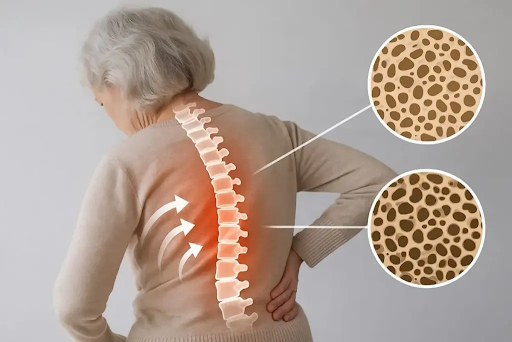
Two diagnoses, one slope. The gentler-sounding one puts more people in hospital.
Two women left the same clinic on a Tuesday holding scan results. The first was given the word osteoporosis and went out white as a sheet. The second heard osteopenia, picked up the word borderline somewhere in it, and was cheerful by the lift. Six years on, it was the cheerful one whose hip went. The frightened one had gone straight into osteoporosis treatment and never let it slide. The other one did little, mostly because nobody sat her down and told her that doing nothing was itself a choice.
They are not two diseases. They are one disease caught at different depths, and the only thing dividing them is a T-score. Anything above -1.0 is considered normal bone. The osteopenia band runs from there down to -2.5, and once a score drops under that figure, the diagnosis becomes osteoporosis, which raises a question about the women scoring -2.4 and -2.6. Their bones are, for practical purposes, the same. They go home with different words. The cutoff is there to give clinicians a place to stand when they decide what to do next, and that is all it was ever meant to be.
Here is what upends the conversation. Most fragility fractures do not happen to people with osteoporosis. They happen to people with osteopenia. It sounds wrong until you do the arithmetic: far more people sit in that middle band, so even at lower individual risk, the group snaps more bones overall. Which makes the reassurance dangerous. Osteopenia is not a clean bill of health. It is a warning that arrived early enough to act on, and for a lot of people osteoporosis correction treatment never becomes necessary precisely because they moved at this stage instead of the next one.
You cannot feel either one. No ache, no stiffness, nothing that would send anyone to a doctor, which is why most of it gets found late or by accident. The only thing that tells you is a bone density test Dubai clinics do, a DEXA, which is over quicker than the drive there and asks nothing of you but lying still. Women are usually pointed toward one at 65, men at 70. Go sooner if your history says to: a bone broken in a fall that should not have broken it after 50, years on steroids, a parent whose hip went, smoking, a small frame. And note where you live. With 78 to 80% of people here short on vitamin D, the base odds are poor.
Strip the Latin away, and osteopenia explained comes down to a race nobody wins forever. Bone is alive, torn down and rebuilt constantly, and until about 30 the rebuilding keeps up. After that, demolition edges ahead by roughly 1% a year, and when oestrogen drops at menopause, that can double for a few years. So this early bone loss stage is not a disease so much as a trajectory, and trajectories can be altered, which is the entire point of catching it.
At this stage, what works is dull and cheap. Fix the vitamin D and calcium first, since a deficiency undoes everything after it. Then load the skeleton, weights and weight-bearing work, because mechanical stress is the one signal bone answers. Stop smoking, ease off the drink. Whether medication enters it depends on a FRAX score, not the T-score alone: broadly, a ten-year risk above 3% for hip or 20% for major fractures is where drugs get considered. Plenty in the osteopenia band go their whole lives without a prescription. Sorting out who needs one is a job for a doctor holding the whole file, and no article substitutes for that.
The osteopenia to osteoporosis progression is not a sentence anyone has to serve. It is a slope, and how fast someone slides down it depends heavily on what happens after the scan. Osteoporosis is the harder version of the same problem, treatable but stubborn, and usually diagnosed once something has already broken. Osteopenia is the same problem while it is still cheap to fix. The difference between the two women who left that clinic was never the diagnosis. It was what each of them did on the drive home.