 By ENGRNEWSWIRE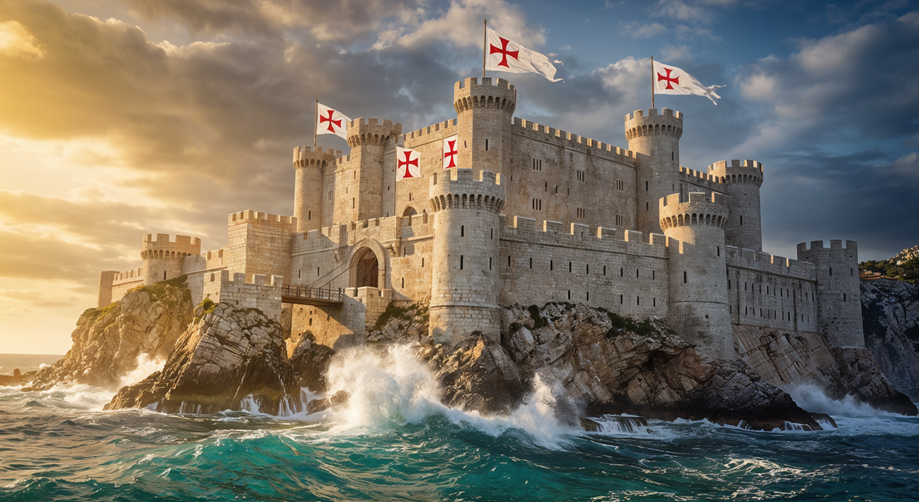
On a narrow promontory jutting into the Mediterranean south of Haifa, the ruins of Castle Pilgrim still defy the waves. Built in 1218 during the Fifth Crusade, this fortress — known to its builders as Château Pèlerin and to locals as Atlit — was the single most ambitious military construction the Knights Templar ever attempted. Its seaward walls rose directly from the bedrock, battered by salt spray, while two massive towers flanked a landward curtain wall that stretched over thirty meters high and six meters thick. No army ever breached it.
The Templars were not merely warrior-monks; they were visionary builders whose castles redefined what a fortress could be. Anyone exploring the legacy of crusader castles and their builders quickly discovers that these structures were centuries ahead of their time. From the Syrian coast to the hills of Galilee, the Order raised fortifications that blended Eastern and Western engineering traditions into something entirely new — and devastatingly effective.
Castle Pilgrim was born out of desperation. By the early thirteenth century, Crusader holdings had shrunk to a thin coastal strip, and the great inland fortresses were lost. The Knights Templar, under Grand Master Guillaume de Chartres, chose the rocky headland at Atlit precisely because the sea protected three sides. Only the eastern approach required heavy fortification, and the Templars made it formidable. Workers cutting foundation trenches struck ancient Phoenician ruins and repurposed the dressed stone — a pragmatic decision that accelerated construction enormously.
The eastern wall featured two rectangular towers, each roughly 34 meters tall, connected by a curtain wall with a vaulted fighting gallery at its top. A dry moat carved from the bedrock separated this wall from the mainland. Behind it stood a second, inner wall — making Castle Pilgrim one of the earliest concentric castles in the Levant. The fortress included a harbor, a church, salt pans, orchards, and freshwater wells, meaning it could sustain a garrison indefinitely by sea even if besieged by land.
In 1220, the Ayyubid sultan al-Mu’azzam Isa launched a major siege against Atlit. His forces battered the outer defenses for weeks but could not penetrate the main curtain wall. The garrison, resupplied by Venetian galleys, held firm. Al-Mu’azzam withdrew. Subsequent attempts fared no better. Castle Pilgrim would only be abandoned — never conquered — when the last Crusaders evacuated the mainland in 1291 after the fall of Acre. Today, the site sits within an Israeli military zone, largely inaccessible to researchers, its stones slowly crumbling into the sea.
Further north along the Syrian coast, the city of Tartus preserves the bones of another Templar stronghold: Tortosa. The Templars acquired the city in the mid-twelfth century and transformed its cathedral into the core of a fortified compound. What made Tortosa unusual was this fusion of sacred and military architecture. The chapel of Our Lady of Tortosa — supposedly one of the earliest churches dedicated to the Virgin Mary — sat within walls bristling with arrow loops and topped with crenellations.
Saladin captured Tortosa in 1188 during his sweeping campaign after Hattin, but the Templars retook it just four years later during the Third Crusade. They rebuilt extensively, adding a massive rectangular keep with walls up to five meters thick and a sophisticated system of internal corridors that allowed defenders to move between positions without exposing themselves to enemy fire. The outer enceinte incorporated towers at regular intervals, each designed to provide enfilading fire along the wall faces — a technique borrowed from Byzantine military architecture.
Tortosa was the last Templar fortress on the Syrian mainland. The garrison evacuated to the offshore island of Arwad in 1291 and held that tiny rock until 1302 or 1303, making it the final Crusader outpost in the Holy Land. The keep at Tartus still stands, now housing Syria’s national museum. Its massive stones, fitted with barely a knife-blade’s gap between them, testify to the precision of Templar masons.
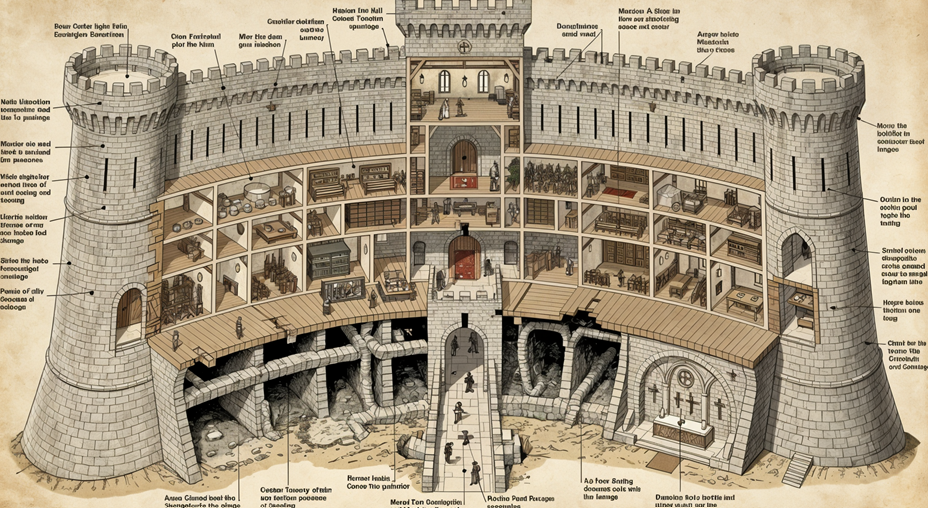
Not all Templar fortresses hugged the coast. Safed, perched on a hilltop in Upper Galilee at roughly 840 meters above sea level, commanded the road between Acre and Damascus. The Templars rebuilt the castle in 1240 with financing from Benedictine bishop Benedict of Alignan, who left a rare contemporary account of the construction. According to his report, the project employed over a thousand laborers daily for two and a half years. The result was a concentric fortress with a central tower, seven outer towers, and a deep rock-cut ditch.
Safed’s engineering responded to its inland position. Without the sea as a natural moat, the designers relied on steep scarps, glacis slopes covered in smooth plaster to prevent scaling, and overlapping fields of fire from elevated tower positions. The castle also served as an administrative center, with the Templars governing the surrounding district and collecting revenues from sixty local villages.
In 1266, the Mamluk sultan Baybars besieged Safed. After weeks of resistance, he reportedly offered the garrison safe conduct. When the Templars and their Syrian Christian auxiliaries marched out, Baybars executed them all. It was a brutal end to a fortress that had symbolized Crusader resilience. Baybars rebuilt Safed as a Muslim stronghold, and its ruins remain visible in the modern Israeli city of Tzfat, though heavily altered over the centuries.
High in the Amanus Mountains near the modern Turkish-Syrian border, Baghras — known to the Crusaders as Gaston — controlled the Belen Pass, a critical route linking Cilician Armenia to the principality of Antioch. The Templars held this castle intermittently from the mid-twelfth century, fortifying its already imposing position with a series of vaulted halls, cisterns, and a chapel carved partly from the mountain itself.
Baghras fell to Saladin in 1188 but was reoccupied by the Templars around 1191 without a fight — Saladin had dismantled parts of its defenses, and the Templars painstakingly restored them. The castle became a source of bitter friction between the Templars and the Armenian King Leo II, who also claimed authority over the pass. This dispute, involving papal arbitration and threats of excommunication, shows how Templar fortresses were as much political instruments as military ones.
The ruins of Baghras survive in southeastern Turkey, still remarkably intact. Massive barrel-vaulted chambers, a gateway with a bent entrance designed to slow attackers, and extensive cistern systems are all visible. It remains one of the best-preserved Templar sites anywhere, yet it receives relatively few visitors.
Beneath the streets of modern Acre lies one of the most remarkable feats of Templar engineering: a 350-meter tunnel connecting the Templar quarter to the harbor. Rediscovered in 1994 when a homeowner reported a blocked drain, the tunnel was carved through bedrock and lined with carefully dressed stone. It stands roughly two meters high and runs in a straight line beneath the city.
The tunnel’s purpose was strategic evacuation. Acre was the de facto capital of the Crusader states after the fall of Jerusalem in 1187, and the Templar compound was essentially a fortress within a city. If the walls were breached, the tunnel provided a direct route to the harbor. During the catastrophic siege of 1291 by the Mamluk sultan al-Ashraf Khalil, the Templar marshal Peter de Sevrey used these passages to coordinate a last defense before the order’s headquarters collapsed onto both defenders and attackers. Today, visitors can walk the restored tunnel, fluorescent lights revealing the chisel marks left by thirteenth-century masons.
The castle-building expertise the Templars developed in the Holy Land did not stay there. Returning Crusaders and military architects carried Eastern innovations westward. Concentric castle design — the use of multiple rings of walls, each higher than the last — appeared in the Levant decades before it became standard in Europe. Edward I of England, who had visited Acre and witnessed Crusader fortifications firsthand during the Ninth Crusade in 1271-1272, later employed concentric principles at Caernarfon, Beaumaris, and Harlech in Wales.
Arrow slits with widened inner embrasures, bent entrance passages, machicolations, and the systematic use of glacis slopes all trace their European adoption to Crusader-era experimentation. The Templars did not invent all of these features — many originated in Byzantine and Islamic traditions — but they served as a critical conduit, testing and refining them under real combat conditions before the concepts migrated west.
What remains of these fortresses varies widely. Castle Pilgrim is off-limits behind military fences. Tortosa’s keep doubles as a museum in war-torn Syria. Safed’s traces hide beneath later Ottoman and modern construction. Baghras stands open but neglected on its Turkish mountaintop. The Acre tunnel welcomes tourists year-round.
Each site holds answers that historians and archaeologists are still pursuing. How did Frankish, Byzantine, and Islamic building traditions merge in real time? What logistical systems supported construction projects employing thousands of workers in hostile territory? How did fortification design respond to counterweight trebuchets and mining techniques? The stones hold evidence that written records do not.
These castles were never just walls and towers. They were statements of intent — built by an order that believed it would hold the Holy Land forever. That the Knights Templar were wrong about permanence makes the engineering no less extraordinary. Seven centuries of earthquakes, warfare, neglect, and scavenging have not erased them entirely. The promontory at Atlit still juts into the sea. The keep at Tartus still stands. And beneath Acre, the tunnel still runs straight and true toward the harbor.
 Torin
Torin  Zarshal seo