 By ENGRNEWSWIRE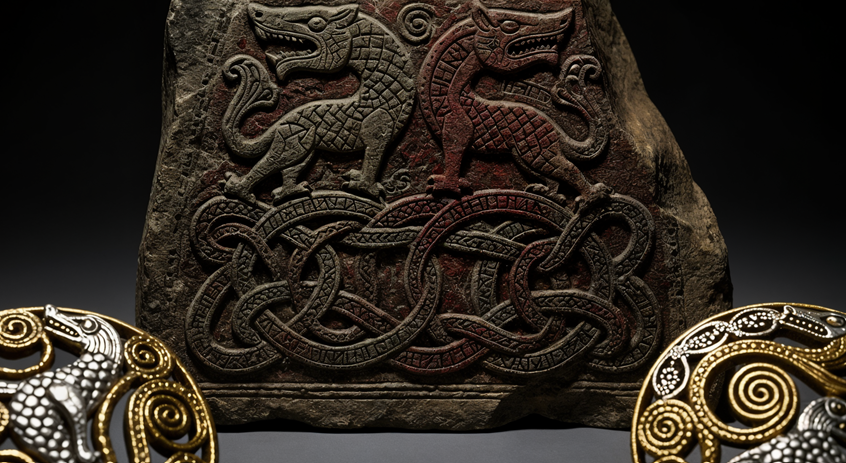
When archaeologists opened the Oseberg burial mound in 1904, they uncovered more than a ninth-century ship. They found a statement of identity carved into every timber, woven into every textile, and hammered into every piece of metalwork. The Viking style that emerged from Scandinavia between the eighth and eleventh centuries was never merely decorative — it was a visual language that communicated status, belief, and belonging. Anyone interested in exploring Viking history and mythology quickly discovers that aesthetics sat at the core of Norse society. From the gripping-beast motifs on a brooch to the serpentine carvings on a warship’s prow, every surface was an opportunity to tell a story.
Understanding these artistic traditions requires looking at them the way the Norse themselves did: not as separate categories of art, craft, and fashion, but as a single interconnected system of meaning.
Clothing in the Viking Age was functional, but it was never plain. A free Norse woman’s outfit centred on the hangerok, an apron dress held up by a pair of oval brooches — the so-called tortoise brooches that appear in graves from Birka to the British Isles. These brooches were cast in bronze, often gilded, and decorated with animal interlace patterns that varied by region and period. They weren’t just fasteners. They announced where a woman came from, whom she was connected to, and what she could afford.
Men signalled rank through arm rings, neck rings, and cloak pins. The silver hoard discovered at Cuerdale in Lancashire in 1840 — one of the largest Viking-age silver finds ever — contained hack-silver alongside intact arm rings and brooches, revealing how jewelry served double duty as both adornment and portable wealth. A chieftain distributing arm rings to his warriors wasn’t simply being generous; he was binding them to him through a visible, wearable bond that everyone in the hall could see.
Textile work carried its own sophistication. Fragments recovered from the Oseberg ship burial include tapestries depicting processions, riders, and what appear to be ritual scenes, all executed in bright dyes made from weld, madder, and woad. The idea that Vikings dressed in dull earth tones is a modern myth. Colour was prestige. Saga literature reinforces this point repeatedly — the Laxdæla saga describes Guðrún Ósvífrsdóttir’s wardrobe in detail, noting her scarlet clothing and elaborately decorated headwear. High-status individuals were expected to look the part, and failing to dress appropriately for one’s rank could invite social scorn.
A Viking warrior’s sword was often the most expensive object he owned, worth as much as sixteen milk cows according to some saga-age valuations. Naturally, the hilts and pommels of high-status weapons received lavish decoration. The Gjermundbu sword, found alongside the only complete Viking-age helmet ever recovered in Norway, features silver-inlaid geometric patterns on its hilt. Pattern-welded blades, forged by twisting rods of iron and steel together, created a rippling surface that the Norse called the ‘serpent in the steel.’ It was engineering and art fused into one.
Axe heads, too, received ornamental treatment. The Mammen axe — unearthed in 1868 from a rich burial in Jutland, Denmark — is inlaid with silver wire depicting a stylized bird on one face and a foliate pattern sometimes identified as Yggdrasil on the other. This single artefact gave its name to an entire decorative period, the Mammen style, characterised by bold, rounded animal forms with double-contoured bodies and tight spiralling tendrils. It marked a transitional moment in Norse art, bridging the geometric precision of the earlier Jellinge style and the elaborate, ribbon-like interlace of the Ringerike style that followed.
Nothing embodied Norse visual ambition quite like the longship. The Oseberg ship, now housed at the Viking Ship Museum in Oslo, stretches twenty-two metres long and features a spiralling prow carved with gripping-beast motifs so dense they seem to writhe when light moves across the wood. The ship was built around 820 CE and buried in a ceremonial mound for two high-status women. Its carvings belong to what scholars call the Oseberg style — the earliest named phase of Viking art, defined by its compact, intertwined animal figures that grip the borders of the frame they inhabit.
Other vessels were no less impressive. The Gokstad ship, found twelve kilometres from the Oseberg site, shows a more restrained aesthetic but equally masterful construction. The shields mounted along its gunwales were painted alternately in black and yellow, turning the hull into a moving display of colour and pattern. Contemporary accounts from Arab traveller Ibn Fadlan and Frankish chroniclers describe Norse ships arriving with carved dragon heads, gilded wind vanes, and painted sails — spectacles designed to terrify enemies and impress allies in equal measure. Norse law codes from Iceland even required approaching ships to remove their dragon-head prow carvings before entering port, lest the land spirits be frightened. The ship was not just transport. It was a mobile monument to its owner’s power and taste.
While ships and jewelry travelled, runestones stayed put. They were meant to endure. More than three thousand runestones survive across Scandinavia, the greatest concentration in the Swedish province of Uppland. Most date from the late tenth and eleventh centuries, and their visual programmes are as significant as their inscriptions.
The Jelling stones in Denmark represent the pinnacle of this tradition. Erected by King Harald Bluetooth around 965 CE, the larger stone bears three carved faces: a runic inscription declaring Harald’s unification of Denmark and conversion to Christianity, a depiction of Christ entangled in interlace, and a great beast locked in combat with a serpent. That great beast panel is the defining image of the Mammen style and arguably the single most famous piece of Viking-age art in existence. Its lines are confident, sweeping, and deeply carved — a public monument meant to be read from a distance.
Earlier runestones from the Borre period (roughly 850–950 CE) feature ring-chain patterns — symmetrical interlocking loops that create an almost hypnotic rhythm across the stone’s surface. The Borre style takes its name from a ship burial site in Vestfold, Norway, where gilt-bronze harness mounts showed the same motifs. These patterns may look purely abstract to modern eyes, but they carried cosmological weight. Some scholars interpret the interlocking loops as references to fate and the interconnection of the nine worlds in Norse cosmology. Others see them as protective bindings, similar in spirit to the magical staves described in later Icelandic grimoire traditions. Whatever their original intent, their visual rhythm remains instantly recognisable.
Viking style never really disappeared. It went underground for centuries, resurfacing periodically in Scandinavian folk art, Romantic nationalism, and the Arts and Crafts movement. The dragon-style stave churches of medieval Norway — like the twelfth-century Urnes stave church, a UNESCO World Heritage Site — carried animal interlace directly from the Viking period into the Christian Middle Ages. The Urnes style, in fact, is the last of the six named phases of Viking art, characterised by graceful, thin animals intertwined in asymmetric figure-eight compositions.
In the twentieth century, Norse visual motifs found new audiences through fantasy literature, heavy metal album art, and eventually film and television. The success of shows and films set in the Viking world has driven enormous popular interest in Norse knotwork tattoos, replica jewelry, and historically inspired clothing. But the influence runs deeper than pop culture. Contemporary Scandinavian design — with its emphasis on clean lines, natural materials, and functional beauty — echoes principles that Viking-age craftspeople understood instinctively. A well-made object should work perfectly and look remarkable doing it.
Tattoo artists today draw directly on the Urnes, Mammen, and Borre styles, sometimes faithfully reproducing motifs from specific artefacts. Jewelers forge Thor’s hammer pendants and Valkyrie figures using traditional casting methods. Re-enactment communities across Europe and North America reconstruct Viking-age textiles using hand-spun wool and plant-based dyes, striving for the same vibrancy that the Oseberg tapestries once displayed. Even high fashion has taken notice: runway collections have featured knotwork embroidery, layered silhouettes inspired by Norse dress, and hardware that echoes the geometry of tortoise brooches. The aesthetic vocabulary the Norse created turns out to be extraordinarily versatile — as effective on a modern silver pendant as it was on a tenth-century runestone.
The Norse expansion lasted roughly three hundred years. The visual culture it produced has now persisted for over a thousand. That longevity isn’t accidental. Viking-age artists created a design vocabulary so powerful, so internally coherent, and so adaptable that it could move from a ship’s prow to a runestone to a brooch without losing its identity. Each named style — Oseberg, Borre, Jellinge, Mammen, Ringerike, Urnes — built on what came before while pushing toward something new.
What the Norse left behind was more than artefacts under glass. They left a grammar of ornament: gripping beasts that refuse to let go of their frames, serpents that coil through impossible geometries, and great animals that strain against the borders meant to contain them. These images spoke to a people who valued bold action, intricate skill, and stories that demanded to be told. A millennium later, they still do.
 Torin
Torin  Zarshal seo